Our News
2025’s Annual RACE Report Findings
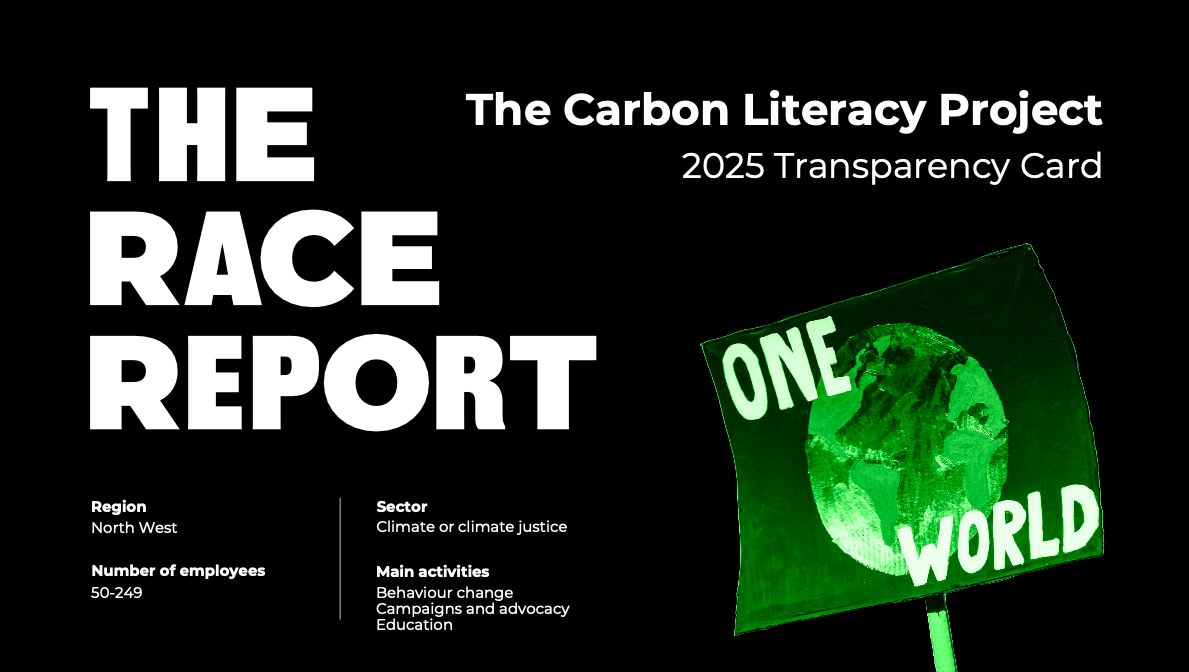
The fourth annual RACE Report, released on 2nd February 2025, is the UK’s largest analysis of the racial diversity of the environmental charity and funder sector. 137 organisations have submitted data, with over 28,000 employees included within this year’s dataset. The Carbon Literacy Project is pleased to be part of a select group to have shared data for all four years of the RACE Report.
The RACE Report Key Findings
Across all organisations submitting data, 4.7% of staff identify as people of colour or ethnically minoritised groups, up from 4.5% in 2024. However, among the 91 organisations that submitted data for the four consecutive years that the RACE Report has been published, representation has increased from 6.2% in 2022 to 8.4% in 2025.
Racial diversity representation within the environmental charity and funder sector remains well below the UK workforce average, with 17% of the UK’s working population identifying as Black, Asian or other minority ethnic identities. It’s also important not to ignore the challenging political context that makes the RACE Report and similar initiatives even more vital.
A sense of belonging within organisations can only be ensured if all values and ethics are reflected and represented among the team. This year’s RACE Report found that:
- 64% of people of colour feel they belong in their organisation (vs 83% of white respondents)
- 65% of people of colour feel valued for their contributions (vs 80% of white respondents)
- 10% of people of colour report witnessing or experiencing racial discrimination, harassment or bullying in the past two years (vs 5% of white respondents)
This year also saw an increase in voluntary intersectional reporting, with 34 organisations submitting data on one or more of the following characteristics: age, disability, gender reassignment, marriage and civil partnership, pregnancy and maternity, race, religion or belief, sex, and sexual orientation. The results indicate that people of colour are disproportionately represented across several other minoritised identities, underscoring the importance of understanding diversity in its full complexity.
Carbon Literacy Project Results Highlights
Despite disparities in representation of minorities within the overall sector, organisations such as The Carbon Literacy Project and others in the ‘climate or climate justice’ umbrella had the largest representation of ethnically minoritised groups (16.3%).
Some other Project highlights from the RACE Report include a 5% increase in the number of staff from racially minoritised groups among our overall staff headcount from 2024. For those employees at CLP who were promoted in the last year, our RACE Report data show that those who gained a promotion and were also from a racially minoritised background had increased by 11% from the previous year. There was a further 300% increase in the number of managers who identified as belonging to a racially minoritised group, demonstrating CLP’s truly inclusive approach to action. This year’s report found a 7% increase in the number of racially minoritised groups represented across the entire staff team, including a 60% increase in the number of racially minoritised groups represented across people managers.
60% of the Carbon Literacy Project workforce identify as women, a stark increase from 2024’s report. This is, however, most likely due to the increase in reporting of gender compared to last year’s report. The age demographics indicate that the most common age bracket at the CLP is ages 25-34, closely followed by ages 18-24 and 45-55, respectively.
Carbon Literacy Project Attitudes and Action on Equity, Diversity and Inclusion (EDI)
At The Carbon Literacy Project, we recognise that, to address the climate crisis, we need to develop a truly inclusive approach to action. Climate change affects everyone, but not equally. This means that our goal of creating a low-carbon culture must reflect the diversity of communities we serve. Equity, Diversity and Inclusion (EDI) are embedded in our culture and organisational practices. We are committed to maintaining an environment where all individuals, regardless of background, identity or circumstance, feel welcome, valued and empowered to contribute to our goals. We have comprehensive EDI policies in place, which guide our overall principles and recruitment to ensure consistent fairness and transparency. These policies are made available to all colleagues and volunteers during onboarding and are regularly reviewed.
Last year, we developed and launched our own EDI training, which everyone at the Project is required to complete. This training has been designed to highlight understanding and shared responsibility across the team for ensuring that EDI principles are actively practised and encouraged. Along with this training, we are committed to ongoing learning and improvement. We listen to opinions, collect feedback and review our processes and policies regularly, with the aim of consolidating our involvement and embedding EDI into our core values and goals. EDI is not seen as separate from our climate mission, but as a central aspect of it.
We’d like to thank everyone in The RACE Report team for their ongoing support. We hugely value being involved in the Report, as we know that measuring where we are currently at, versus where we need to be, is the only way we can better understand and improve, year on year.
Find our transparency card and read the 2025 RACE Report in full at race-report.uk.