Our News
Dear Andy Burnham, Here’s The Future We’d Like to See
With Andy Burnham newly appointed at Number 10, and No.10 North all of ten minutes’ walk from CLP HQ, we asked our team a simple question: if they could create a manifesto for the new Prime Minister, what would make the list? The result was our very own fantasy manifesto, a collection of ideas ranging from the ambitious to the unconventional.
Some suggestions may not be oven-ready to survive their first cabinet meeting, such as requiring everyone in government to wear green suits or giving everyone a free day at the seaside to boost morale. Although unlikely to feature at the top of the Prime Minister’s immediate to-do list, these ideas certainly got the conversation started. We might have been inspired by the Hon. Count Binface here.
Once we’d exhausted our more imaginative policy-making instincts, some clear priorities began to emerge. Across different staff groups, the same themes repeatedly appeared: transport, homes, energy and, most consistently of all, climate education.
No More Car-Shaped Cities
If there was one policy area our team returned to again and again, it was transport.
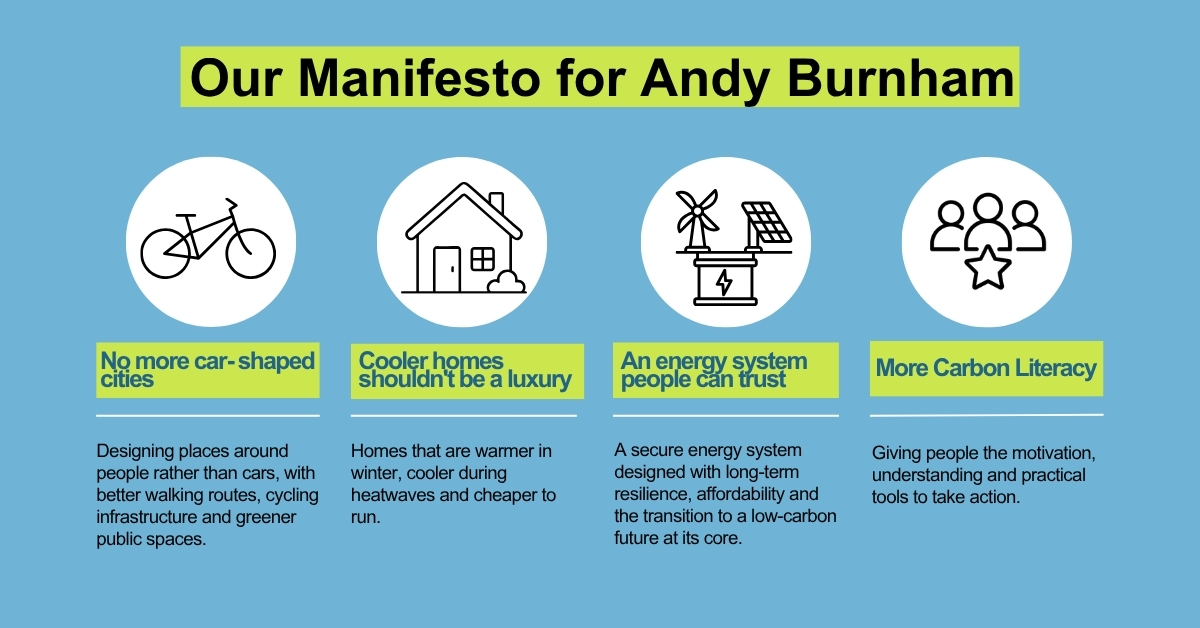
Suggestions ranged from scrapping aviation fuel subsidies and increasing the cost of frequent flying, to making public transport more affordable and improving connections between towns, cities and rural communities. Others imagined places designed around people rather than cars, with better walking routes, cycling infrastructure and greener public spaces.
What connected these ideas was a recognition that transport shapes far more than how we get from A to B. It influences access to jobs, health, social connection and opportunity, while also playing a major role in reducing emissions. Creating a low-carbon transport system is therefore about more than changing vehicles or building new infrastructure. It is about designing places where climate-friendly choices are practical, affordable and accessible for everyone.
Given Burnham’s long-standing association with championing public transport in Greater Manchester, it’s no surprise that he’s already signalled that affordable public transport and stronger local decision-making will be central to his governance, making our team’s discussion feel less like fantasy and more like a conversation about where those ambitions could go next.
Cooler Homes Shouldn’t Be a Luxury
The second major theme was the places we live. Colleagues repeatedly returned to the need for homes that are warmer in winter, cooler during heatwaves and cheaper to run. Ideas included stronger building standards, large-scale retrofit programmes, more support for heat pumps and solar panels, and street-by-street approaches to upgrading existing housing.
One particularly ambitious proposal imagined government-funded solar panels, with the income generated by the electricity going back to government spending, helping to fund future investment while making renewable energy more accessible.
These suggestions showed the importance of considering the everyday implications of climate change, navigating how to offer homes that are better suited to a changing climate, using more sustainable and affordable methods.
Building an Energy System People Can Trust
Energy policy was another area where common ground emerged, with colleagues questioning not only how we generate power, but also how the system itself is designed.
Several groups challenged the current link between electricity prices and the cost of gas, while others imagined greater investment in renewable energy, more local energy generation and reduced reliance on imported fossil fuels. Although the proposals approached the issue from different angles, they all pointed towards the same question: what should a better energy system actually look like?The discussion suggested one that makes clean energy easier to access, gives communities more control over where their power comes from and helps protect households from the uncertainty of volatile energy prices. Rather than relying on quick fixes, our team imagined a secure energy system designed with long-term resilience, affordability and the transition to a low-carbon future at its core.
Top of Our Manifesto? More Carbon Literacy of Course!
While transport, housing and energy dominated the conversation, one proposal was at the core: climate education.
Many groups imagined Carbon Literacy becoming a standard part of school life, with students leaving education Carbon Literate and teachers receiving Carbon Literacy training too. Some went further, suggesting that climate education should become as fundamental as maths or English: a practical life skill that equips people to navigate the decisions they will face throughout adulthood.
Climate change increasingly influences the choices we make every day: how we travel, heat our homes, manage organisations, spend money and interact with our communities. Yet most people are still expected to make these decisions without ever having received structured climate education.
Knowledge alone doesn’t solve the climate crisis, but people who understand the relevance, causes, impacts and solutions are far better equipped to take meaningful action, influence others and make informed decisions within their own roles. That’s exactly the motivation behind our work at The Carbon Literacy Project. It’s about giving people the motivation, understanding and practical tools to take action that is relevant to their lives, workplaces and communities.
Earlier this year, before becoming Prime Minister, Burnham committed to becoming Carbon Literate after seeing first-hand the scale of our impact across Greater Manchester. With more than 168,000 people now certified worldwide, including Burnham’s deputy chief of staff at No 10 North, Caroline Simpson, and his replacement as Greater Manchester Mayor, Bev Craig, we hope he follows through on his commitment to use Carbon Literacy as the foundation of the ambitious climate action needed to turn ideas like these into reality.
From Fantasy Manifesto to Real-World Action
Will Andy Burnham adopt any of our team’s proposals? Maybe not the green suits. But behind the humour sits a serious point: imagining the future we want to see is an important part of creating it.
If we want climate action to become part of everyday decision-making, whether it be in government, organisations or communities, Carbon Literacy has a vital role to play.
Write to your MP sharing our manifesto. Want to add your own ideas? Join an open Carbon Literacy course to gain some inspiration.