Our News
The Benefits of an Active Commute: Build Buy-in This Bike Week
Getting to work, for most of us, is a chore – an hour lost every day. An unavoidable part of our routine – mundane, sluggish, stressful, and altogether not very good for our body or mind.
In this journey, there often lies a cost. For employees, it’s stress, fatigue and hours lost each week. For companies, it means lower productivity, higher absenteeism and difficulties keeping and hiring talent. And for cities, it’s traffic, noise and air pollution that never seems to stop. Until recently, these impacts were seen as a product of personal convenience. Now they’re recognised as part of a company’s environmental footprint and metrics that determine our quality of life.
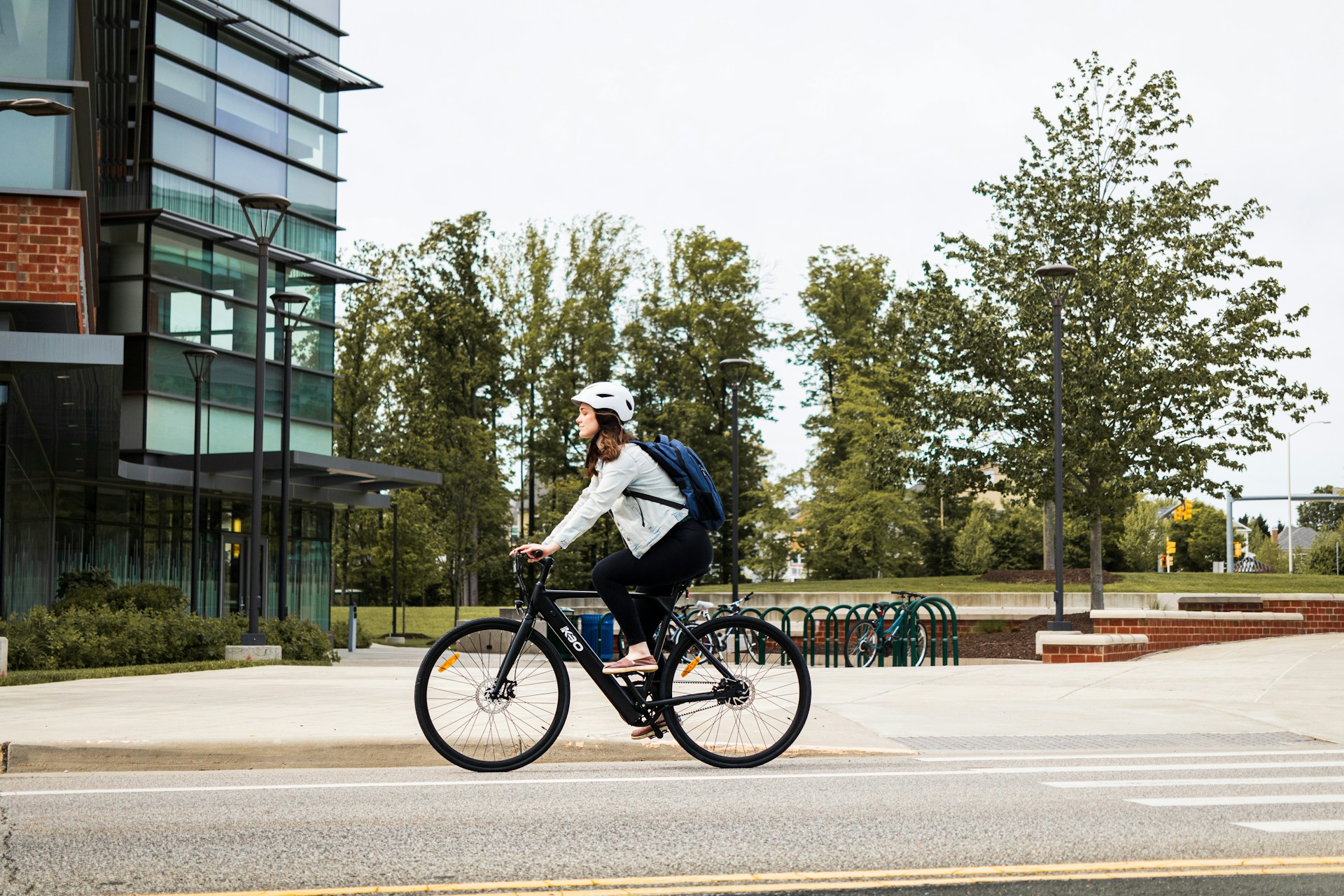
This week, between the 8th and 14th June 2026, Bike Week returns! We’re invited to reconsider how we approach the school run and our commute to work. We’re encouraged to explore our local greenways & cycle infrastructure, and to feel the energising benefits of fresh air before our first Monday-morning strategy meeting!
Productivity and Wellbeing
Many of us are probably aware of the Cycle to Work Scheme. It’s helped over 2 million people access a bike over the past 25 years. By making active travel easier, the scheme enables people to feel fitter, more energised and more productive.
Cycle to Work participants take fewer sick days, they put less pressure on the NHS, and they have fewer financial burdens. In the office, 90% of employers report that their workforce is healthier since introducing the Scheme, helping to embed a healthy workplace culture.
The benefits are numerous. For each individual who regularly cycles to work instead of driving, we save roughly 700 kilograms of CO₂e per year. Multiplied across thousands of organisations and millions of employees, the cumulative impact is transformative.
Adapt and Overcome
Commuting accounts for roughly 5% of the UK’s total carbon footprint. This is anything but negligible in the big picture of Net Zero. Developments in Carbon Accounting compliance and further emphasis on ESG frameworks mean that, to maintain a competitive edge, businesses are expected to understand and effectively report their direct and indirect carbon emissions.
From January 2027, UK Sustainability Reporting Standards (UK SRS S2) will require many companies to measure and disclose the full environmental impact of their operations, including how their employees travel to and from work. This falls under Scope 3 emissions: the indirect greenhouse gases generated, in this case, by staff commuting between home and the workplace.
Having been officially published in February 2026, with a phased rollout until the end of the year, the new legislation recommends that businesses of all sizes get a head start in ironing out their carbon accounting and begin (if not already) reporting on their climate-related strategic goals. For many organisations, this will be unfamiliar territory. But understanding where our emissions come from is key to facilitating this transition. The more embedded this understanding is across the workforce, the smoother and simpler this transition will be.
Companies are already embedding ambitious strategies – targeting healthier employees, reduced emissions, and neighbourhoods that breathe a little easier.
Collaboration and Buy-in – Freedom Leisure
Freedom Leisure is a not-for-profit leisure centre trust with a workforce of over 6000 individuals, operating over 130 facilities, and welcoming more than 23 million visitors annually. With such a geographically dispersed outreach, a small sustainability team couldn’t deliver the solutions alone. Success requires buy-in from every level, from site managers to frontline staff.
For Freedom Leisure, their Carbon Literacy training has led to incredible improvements:
- More than 100 Carbon Literate colleagues tasked with leading sustainability in their respective centres.
- Motivation to act rose from 65% to 96%, with a 15% increase in confidence to identify carbon savings
- Colleagues are trained at every level. Including the Executive Leadership Team (for strategic buy-in), Senior & General Managers (for site-level energy use), operational staff (for day-to-day influence over emissions) and Technical & Support staff (for integration in procurement & estate improvement).
Freedom Leisure is an accredited Bronze Carbon Literate Organisation (CLO). Informed by the material in their Carbon Literacy training, they have launched a green travel transformation focused on staff and customer behaviour change, with dozens of staff already choosing to commute by bike, or other means of active travel, as part of their Carbon Literacy training action pledges.
Cycling to work as part of a Net Zero transition has benefits beyond measurement:
- Lowering cortisol stress through engagement with the natural world.
- Boosting cardiovascular health by stimulating our bodies before the work day.
- Elevating our mood, attention, and memory by introducing new habits and variety.
- Cutting our reliance on fossil fuels when going about our workday.
The journey to a lower-carbon commute might look like a cycle-to-work scheme, building protected bike parking, designing safe cycle journey plans, or simply a conversation with a line manager about changing travel habits. It doesn’t need to be dramatic to be meaningful. To initiate and encourage these conversations, we need to fill our organisations with a confident, knowledgeable, holistically informed workforce.
Carbon Literacy offers more than awareness. It provides a structured, action-based framework that directly links climate science to measurable site-level impact. Freedom Leisure’s experience demonstrates that the benefits – emissions reductions, empowered colleagues, financial savings – far outweigh the effort required. And limit uncertainty in the face of change
Get in Touch
With Bike Week here, speak with your colleagues to find out more about Cycle to Work schemes, organise a group ride for all ability levels, or encourage your workplace to invest in improved bike parking facilities.
If your organisation is ready to look at its Scope 3 emissions, or if you’d like to understand more about embedding Carbon Literacy into your workplace culture, we’d love to hear from you.
Contact us or browse upcoming open courses tailored to a whole host of different audiences.
And in the meantime: how will you get to work tomorrow?