Our News
Know When Electricity Costs Less for You and the Planet
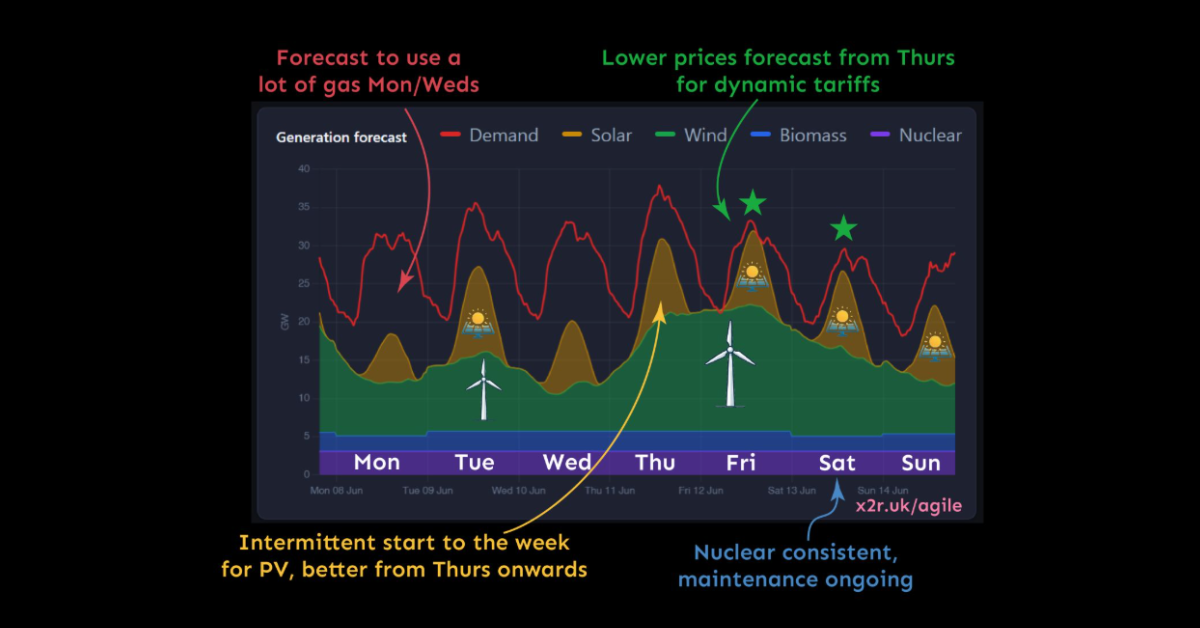
Image credit: Simon Lock, via Octopus Agile Price Forecast
Did you know: if it’s windy and sunny, your electricity can be cheaper with lower emissions?
Wouldn’t it be useful if the weather forecast told you this? That way, you could plan when to do your laundry or charge your electric vehicle to reduce your energy bills and carbon footprint.
Smart climate choices: what more can you do?
Simon Lock is a Sustainability Director for heritage and sustainability consultancy, Woohoo.
As a sustainability professional, Simon’s job involves actively removing emissions from the built environment. Simon decided to undertake Carbon Literacy training to further improve his awareness and knowledge of different aspects of the climate crisis, and also to show a commitment to keep improving and reducing emissions. Being local to Cumbria and knowing the great work they do in the area to support individuals and organisations to reduce emissions, and knowing their reputation for high-quality climate training, Futureproof Cumbria was the obvious choice.
With the knowledge he had, Simon was already doing a lot to reduce his personal carbon footprint: installing a heat pump, eating a predominantly plant-based diet, moving his pension into a sustainable investment funds, switching to a renewable energy provider and to an electric vehicle (EV) – and, cleverly, charging the EV and appliances and timing other energy usage when there is the greatest wind or most sun and when the grid emissions are lowest.
So, what more could he do?
The course with Futureproof Cumbria inspired Simon to think about other steps he might take. Part of Simon’s Carbon Literacy pledge was to share his knowledge and personal experience of low-carbon technologies with as many people as possible.
A vague action, one might say. What does this look like, and what could it achieve, in practice?
The ripple effect of sharing knowledge
When starting these conversations, Simon stumbled across something that, to him, seemed obvious:
This year, while in an energy crisis, Britain has collectively wasted over £800m turning wind turbines off and buying (often non-renewable) energy elsewhere, because the grid can’t cope with the excess of clean energy produced at times of high wind.
So why isn’t the upcoming solar and wind power forecast being broadcast as publicly as possible, to make better use of any excess and prevent waste?
Ideally, as part of the weather forecast, so citizens can plan their electricity usage accordingly, for both cost and emissions reasons.
The Met Office already provides this forecast to the National Grid.
So, he started a petition for the government to issue public solar and wind power forecasts. If it receives 10,000 signatures, the government will have to respond. And as part of the journey, he is spreading the message that if it’s sunny and windy, energy is greener and cheaper.

Image description: An example of what a wind and solar power forecast could look like as part of the daily forecast
How would solar and wind forecasts benefit you?
Know when electricity use will cost less
The vast majority of people (around 91%) are on flat-rate electricity tariffs, paying the same price for electricity regardless of when they use it. Shifting to a time-of-use (ToU) tariff can save money.
Incorporating solar and wind power into weather forecasts for the general public would help people confidently switch to ToU tariffs and easily make decisions about when everyday activities will cost less in energy bills. For example:
- ‘It’s really sunny and windy outside, so I will put my washing out on the line outside and set the washing off inside, as solar panels and wind turbines will be generating cheaper and cleaner energy.’
- ‘I’ve heard that there’s a storm coming overnight, I’ll charge the EV, as there will be plentiful wind power.’
- ‘It’s really overcast with minimal wind today, I’ll do some baking another day’.
Earn money for using electricity
There are ToU tariffs out there that reward using electricity at low-emission times, such as Octopus Agile. Octopus, EDF and other energy companies frequently pay customers to use electricity when there is excess renewable electricity, as it is cheaper than turning off wind turbines.
Last Sunday, for example, due to high wind and solar electricity, Simon earned £1.11 for using electricity when renewable energy was abundant. This Saturday, due to high offshore wind, electricity prices were again negative. So, Simon charged his and a couple of neighbours’ EVs – and was paid to do so.
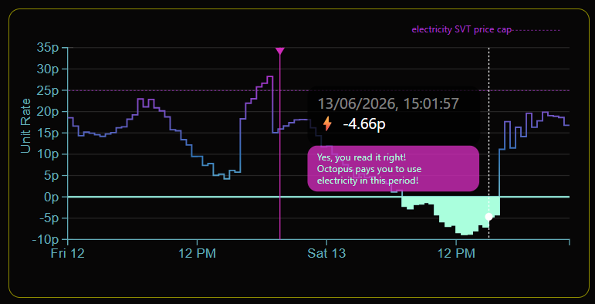
Image description: Simon earned money for using electricity when renewable energy was abundant this Saturday.
Savvy customers have clocked on to this and are chasing the low or negative price periods. But there is no reason why anyone who is struggling with bills can’t do the same.
A general rule of thumb: if you avoid using electricity between 4-7 pm, then your electricity will be below the energy price cap of 25p, and probably by some margin.
As average annual energy bills are set to rise by 13% on 1 July for those on standard price-capped tariffs, it’s a good time to consider whether a ToU tariff could be a better option.
Knock-on benefits for the clean energy transition
Greater awareness of the fact that you can save money by timing electricity usage with wind and solar power peaks would create a higher demand for renewables, likely increasing investment and making renewables even cheaper.
If someone repeatedly sees in the weather forecast that there is high sun coming, so plenty of solar power is available, it may encourage more people to install solar panels, growing the supply of renewable electricity to the grid.
All of this accelerates the transition to Net Zero. Simon tries to use electricity when the grid carbon emissions are under 100 g/kwh. By doing so, he has potentially saved 40%+ of his emissions. Just imagine if the entire population saved 40% of their emissions. That’s huge progress towards Britain’s Net Zero ambitions.
Making this a normal part of daily life
This information is already available, but unless you’re an expert like Simon, it’s not easy to understand and determine when it’s cheapest to use electricity. Making this easily understandable and highly visible as part of everyday forecasts would make these savings accessible to everyone.
If you want the daily forecast to tell you when electricity will be cheaper to use, sign Simon’s petition.
If you want to have a go at understanding the information already available, check out:
The blog image is Simon’s handy interpretation of last week’s forecast to help you get started.
This is the kind of impact a single Carbon Literacy pledge can have. One climate-smart decision made accessible, potentially to a country’s entire population. Want to know what other climate-smart decisions you can make? Or learn what ripple effect you could have? Sign up for a Carbon Literacy course today.